

For a couple of years I’ve been fortunate to serve in an “In Residence” status for the University of Tampa’s nationally recognized Entrepreneurship Program. This involves mentoring both graduate and undergraduate students who as part of their curriculum gain the skills to successfully launch their own venture. The Lowth Center is a world class facility that hosts not only most classes but also a Business Accelerator that “pairs students with a launch team of experts to help formulate business plans and investment presentations” and The Spartan Incubator which is a “lab for early-stage community businesses.” Both provide a fertile ecosystem for creating business plans for innovative products and services.

As an organization that has been assisting product development since 2005 we have seen what has worked in the product development life cycle as well as where companies have failed to launch. It is this experience that has enabled me to share with new product developers the proven steps required to see their aspirations become reality. Critical and absolutely mandatory preparations and planning have to be a part of the journey.
Product Development Life Cycle
- Product design and development
- Product development strategy
- Understanding product development stages
- An investors deck which includes a sound business plan including financials, break even analysis, pro-formas and an overall budget
Launching a new product is vastly different than launching a business.
Seldom does a tangible or physical product constitute a business. Certainly an “App” or invention can become the foundation for a business (Spanx is a good example) but it is in the vision for brand extensions where a product becomes an enterprise which creates value for shareholders.
We have seen thousands of want-to-be entrepreneurs invest their life savings in product design yet haven’t gotten past the product development phase of launching a business. Some products while unique are not destined for commercializing as a stand-alone innovation. The retail landscape is now more complex than ever with e-tailing taking hold as a key distribution channel particularly with new product launches. Selling on Amazon is certainly a great option for new products but this comes with a steep learning curve and is nearly as time and resource intensive as selling through traditional retail (brick and mortar) channels.
The bottom line is that unless you are a business or company with deep pockets and can support a 2-3 year ROI you should carefully weigh how much you invest in a new venture. Licensing products is a sound option for individuals with limited budgets and there are hundreds of experts in this field who can be found on LinkedIn. These professionals have deep relationships with
- Retail buyers in multiple chains who might like to private label under a retail brand
- Brand managers with CPG companies who seek the next innovation in their categories
- Have existing e-tail champions successfully selling on Amazon, e-Bay, Pinterest and other well know sites
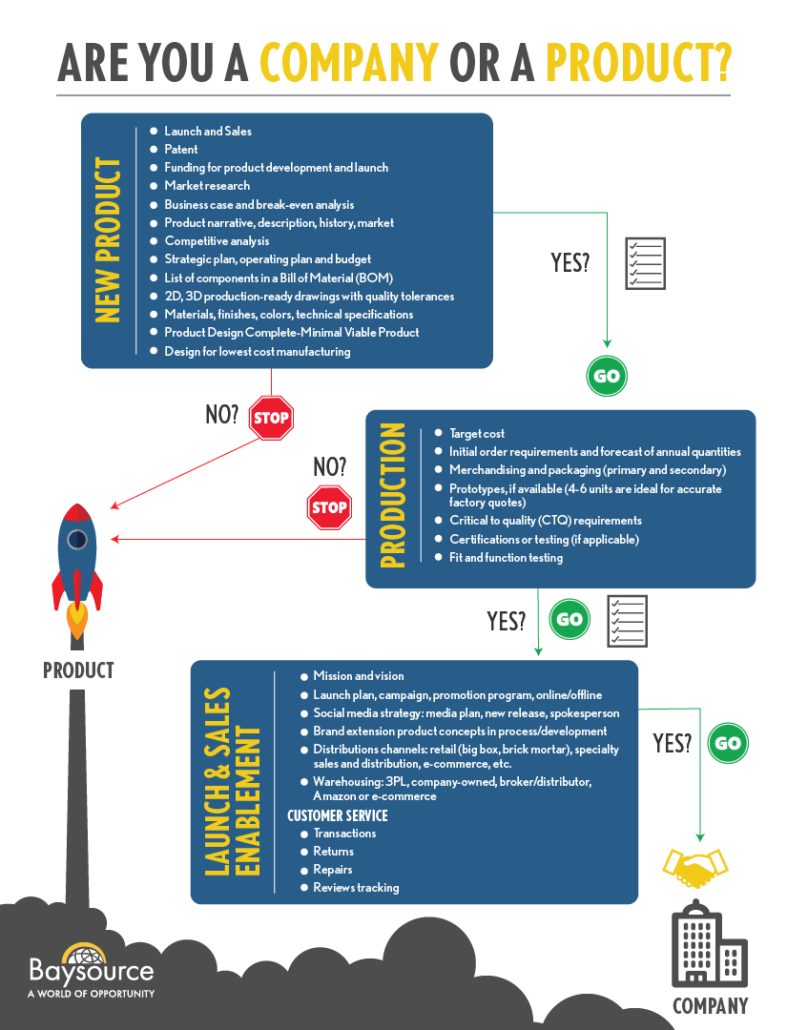
The following infographic can serve as a guide, roadmap and checklist to determine whether you are developing a product or positioned to start a company. You may not have to “check all the boxes” but if you plan on raising capital you should be prepared to address most on the list.
 https://baysourceglobal.com/wp-content/uploads/2026/01/Baysource-Headers-3.jpg
1050
2050
dwatts
https://baysourceglobal.com/wp-content/uploads/2013/04/BSG-new-logo-large1-e1426014540772.jpg
dwatts2026-02-03 19:48:372026-02-18 21:02:53Manufacturing Due Diligence in Asia: What Private Equity Firms Miss Before Close
https://baysourceglobal.com/wp-content/uploads/2026/01/Baysource-Headers-3.jpg
1050
2050
dwatts
https://baysourceglobal.com/wp-content/uploads/2013/04/BSG-new-logo-large1-e1426014540772.jpg
dwatts2026-02-03 19:48:372026-02-18 21:02:53Manufacturing Due Diligence in Asia: What Private Equity Firms Miss Before Close https://baysourceglobal.com/wp-content/uploads/2025/12/global-shipping-containers-supply-chain-disruption-2025.jpg
1050
2050
dwatts
https://baysourceglobal.com/wp-content/uploads/2013/04/BSG-new-logo-large1-e1426014540772.jpg
dwatts2025-12-30 17:56:552026-02-05 01:16:23Sourcing After Supply-Chain Disruption: Lessons from 2025 Global Events
https://baysourceglobal.com/wp-content/uploads/2025/12/global-shipping-containers-supply-chain-disruption-2025.jpg
1050
2050
dwatts
https://baysourceglobal.com/wp-content/uploads/2013/04/BSG-new-logo-large1-e1426014540772.jpg
dwatts2025-12-30 17:56:552026-02-05 01:16:23Sourcing After Supply-Chain Disruption: Lessons from 2025 Global Events https://baysourceglobal.com/wp-content/uploads/2025/12/Baysource-Headers-1.jpg
1050
2050
dwatts
https://baysourceglobal.com/wp-content/uploads/2013/04/BSG-new-logo-large1-e1426014540772.jpg
dwatts2025-12-23 17:23:242025-12-23 17:40:49The Unboxing Economy: Why Custom Packaging From China Still Makes Sense in 2025
https://baysourceglobal.com/wp-content/uploads/2025/12/Baysource-Headers-1.jpg
1050
2050
dwatts
https://baysourceglobal.com/wp-content/uploads/2013/04/BSG-new-logo-large1-e1426014540772.jpg
dwatts2025-12-23 17:23:242025-12-23 17:40:49The Unboxing Economy: Why Custom Packaging From China Still Makes Sense in 2025
Follow Us